Infotourism
Geography of Madrid
With an area of 8,028 km² and administratively bordered by two autonomous communities, Castilla y León (north and west) and Castilla–La Mancha (south and east), the Community of Madrid stands at the geographical center of the Iberian Peninsula, located in southwestern Europe.
Situated 650 meters above sea level—although some mountainous areas exceed 700 meters—the Community of Madrid is defined by several physical boundaries. To the north, the Central System mountain range includes several important peaks; to the south lies a valley crossed by the Tagus River as it passes through Madrid.
A single-province territory, its main city, Madrid, is not only the provincial capital but also the capital of Spain, and is crossed by the Manzanares River, a tributary of the Jarama, which in turn flows into the Tagus River.
Distances in km
- Amsterdam: 1,735 km
- Athens: 4,029 km
- Barcelona: 621 km
- Berlin: 2,360 km
- Brussels: 1,556 km
- Copenhagen: 2,539 km
- Stockholm: 3,163 km
- Lisbon: 644 km
- London: 1,725 km
- Oslo: 3,133 km
- Paris: 1,260 km
- Rome: 2,086 km
- Seville: 538 km
- Valencia: 352 km
- Vienna: 2,444 km
- Milan: 1,189 km
Climate of Madrid
Due to its location, the Community of Madrid has a continental climate.
The average annual temperature is around 14°C; during the coldest months it averages around 5°C, rising to around 25°C in the warmer months.
Rainfall is quite varied, although it tends to be concentrated in autumn and spring, with summer being the driest season.
Average monthly temperatures
- January: 6°C
- February: 5°C
- March: 11°C
- April: 13°C
- May: 19°C
- June: 22°C
- July: 25°C
- August: 26°C
- September: 23°C
- October: 18°C
- November: 10°C
- December: 7°C
Daily customs in Madrid
Madrid is famous for being a very active city, where there is always something to do and people out on the streets. This is partly true, but as anywhere else, there are schedules worth knowing before making plans.
Restaurants generally have wide kitchen hours. Lunch is usually served between 1 p.m. and 5 p.m. Dinner service typically starts around 8:30 p.m. and runs until midnight or even 1 a.m. However, more and more establishments keep their kitchens open all afternoon, allowing meals without strict schedules.
Bars and cafés also have long hours, opening early in the morning (between 7 and 8 a.m.) and closing late (between 11 p.m. and 1 a.m., depending on the venue).
Madrid nightlife offers many options. Nightlife venues usually stay open until 3 or 3:30 a.m., while nightclubs can remain open all night, from midnight until 6:30 or 7 a.m. in some cases.
Madrid has one of the best public transport networks in the world. Buses, metro and commuter trains allow visitors to move around without needing a private vehicle. Buses operate from 6 a.m. until midnight; the metro runs until 1:30 a.m.; and commuter trains run from 5 a.m. to midnight. In addition, a night bus service operates from midnight until 6 a.m., when daytime services resume.
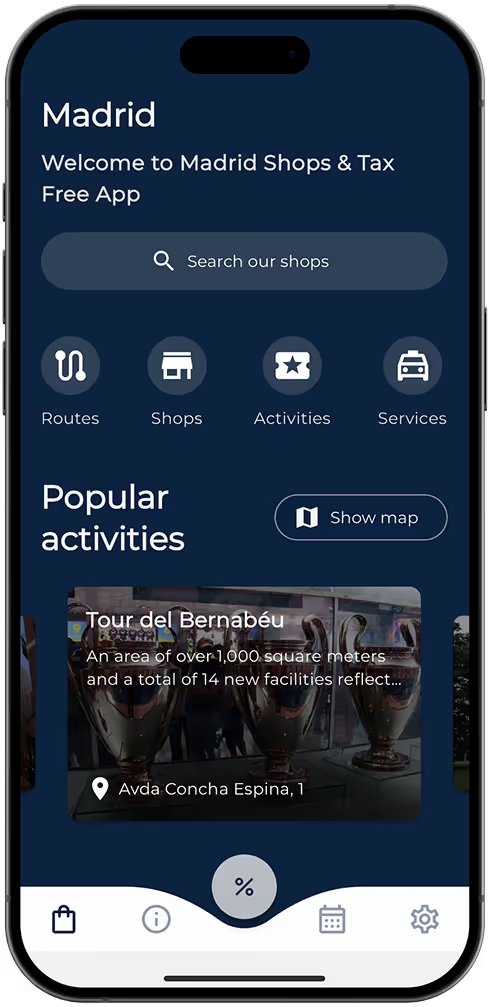
Descarga la aplicación móvil
Descárgate la aplicación móvil de Madrid Shops y conseguirás un mundo de ventajas en la palma de tu mano. ¡Es gratis!
- Tendrás los mejores comercios de lujo de Madrid.
- Conversor de tallas.
- Acceso a actividades.
- Agenda para planificar tu viaje de compras a Madrid.



¡Suscríbete y permanece actualizado!